Deontay Wilder vs. Tyson Fury: Choose Your Champion
Hey, Boxing Fans!
Get ready for an epic clash between two heavyweight titans, Deontay Wilder and Tyson Fury, as they step into the ring once again. With their fame and numerous titles, it’s the ultimate battle to determine who’s the real champ. But here’s the burning question: whose side are you on?
We took the pulse of the boxing world with an Instagram Poll, and the results are in – 59% backing Deontay Wilder, and 41% rallying behind Tyson Fury. Intriguing, right? But that’s just the beginning! Stay tuned as we unveil our coaches’ predictions, including my own!
Join us in the excitement as we count down to witness the fierce showdown between Deontay Wilder and Tyson Fury, two colossal figures in the world of boxing. Whether you’re a die-hard fan or just curious, this match is bound to keep you on the edge of your seat.
And if you’re eager to be a part of the action, head over to our Schedule + Rates page for all the details on when and how to catch this epic battle live. It’s a date you won’t want to miss!
Unlocking the Power Within: How Boxing Elevates Mind and Body
Boxing, with its explosive and powerful nature, offers far-reaching benefits that extend beyond the ring. It’s not just about throwing punches; it’s a holistic approach to harnessing strength and conditioning. In the realm of fitness, the anaerobic style of boxing shines as a versatile contender for a wide range of workouts. But it’s not one-size-fits-all; it’s about crafting routines tailored to your unique physical needs and level of involvement.
In this article, we invite you to delve into the world of boxing and discover the remarkable ways it transforms both your body and mind. The journey to becoming unbreakable, both physically and mentally, is an art that demands unwavering determination, a solid foundation, and the guidance of an exceptional coach. And, as with any significant physical endeavor, it’s wise to consult a doctor before embarking on an intense training program.
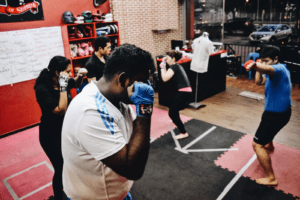
Boxing class in full swing, everyone perfecting their punch techniques.
How Boxing works in a nutshell
Provides a comprehensive full-body workout, targeting and toning all major muscle groups.
Strengthens and enhances the core muscles.
Offers valuable self-defense skills within the context of a combat sport.
Alleviates stress, anxiety, and pent-up aggression through the physicality of pounding heavy and speed bags.
As boxing becomes second nature, it becomes convenient to set up home boxing equipment for training.
Acts as an effective high-calorie burner, aiding in weight management.
Enhances the respiratory and muscular systems through anaerobic workouts.
Prioritizes performance and skill development over aesthetic outcomes.
Boosts self-confidence and self-esteem.
Fosters sportsmanship values despite being a combat sport.
Boxing is demanding. To understand how it helps the body in various ways. We have compartmentalized the structure of the sport into four significant phases.
A motivated gym enthusiast skillfully handles skip ropes during their workout.
Phase 1: The Warm-Up.
Think of a warm-up as your essential first step, a friendly introduction before the real workout begins. It might seem gentle, but it’s the secret to making you stronger. Warm-ups consist of functional exercises that gradually limber up your joints and set them in motion. Always begin at a leisurely pace. Avoid passive stretching; save it for your post-workout cool-down. These activation exercises lay the foundation for your technical and strength training
High Knee Walking does not stress the muscles, instead prepares the muscles for intense workouts.
Fast High Knees help pump up the cardiovascular and nervous systems, igniting them for the main workout.
Walking Butt Kicks is reaching out to your butt. It relaxes and knee flexors and the hamstrings.
Sumo Squats release the thigh tension. It works on the core, abdominals, and lower body.
Arm Circles is an upper body warmup to loosen the shoulders, forearms, and hands.
Jumping rope is much more than a warm-up exercise. It builds focus, hand-eye coordination, balance, and agility in footwork.
Boxer Push-ups help strengthen the shoulders and chest
Planks improve balance and help support posture.
Boxer Bicycle Crunches work on the abs, and legs and improve body coordination.
These are just a few exercises to activate your body and fire up your core.
Our skilled and joyful boxer, confidently lifting dumbbells, ready for the ring.
Phase 2: Strength Training
Strength training, sometimes called resistance training, forms the foundation for muscle development and motor skill enhancement. This phase prepares a boxer’s body for more robust, quicker, and more powerful movements. Think of these exercises as functional, performance-focused workouts rather than mere demonstrations. They’re designed to elevate an athlete’s physical capabilities, employing compound exercises that engage multiple joints and muscle groups simultaneously.
Pull-ups work on the posture, back, rear shoulders, and biceps. To give you that vast space so you can take cover from or hit your opponent.
The seated cable row exercise works on the back muscles and forearms.
Triceps Pushdowns are a great way to build muscle and work on the arms. If you have sustained a prior elbow injury, it is suggested you practice under supervision.
Dips are considered superior to push-ups. You lift your entire body weight, unlike pushups. Building body mass and majorly improving your lockout strength.
The Overhead press builds strong arm and shoulder muscles. To shower those iron fists at lightning speeds on the opponent.
Shadow boxing: It may look like throwing punches in the air. However, results depend on the intensity of your workout. Shadow boxing improves boxing skills, overall body fitness, stance, and flexibility.
Sparring: It helps develop speed, control, and defense tactics. Sparring is an essential form of training to help you familiarise yourself with real-life boxing ring situations.
Agility Ladder: This drill can have numerous variations and improves footwork tremendously.
Boxers should also incorporate free weight exercises into their training regimen because boxing is a dynamic and mobile sport.
A determined female boxer demonstrates perfect form during lunges.
Phase 3: Power Training
Power training demands quick and agile movements, but it also comes with a heightened risk of injury. To prepare for power training, you first establish a strong foundation through strength training. The correct technique is crucial at this stage. As you become/ attuned to your body’s rhythm and capabilities, you’ll naturally adapt to the necessary techniques and fluidity. Remember, every move in boxing has a scientific aspect. Engaging in power training elevates your speed, stability, and overall technique to a higher level.
Back squats: They strengthen the lower body. The correct technique where the hips extend and go lower than the knees transfers the force from the feet to the hips, the core, and effectively when you launch up to punch. Back squats maximize the jump in return aiding the impact of your punch.
Clean and Press: Lift as much weight as the body can take retaining its right position. It demands the tightening of the core and back, throughout. Hip extension plays a vital role in balancing the weight of your body. Keep the bar/dumbbells/kettlebells moving except for brief pauses between sets. Squats take power from the ground up to hand, as boxing requires.
Kettlebell Training: Boxing requires ballistic movements. The kettlebell exercises the muscles, their contractions, and speed. The generation of force after training is how boxers pack that powerful punch. Basic movements like one and two-arm swings, clean, press and push presses are essential before moving on to more complex exercises.
Resistance Bands: Core strength is a must for reliable and powerful movements. It helps in rotational exercises.
Here are a few example exercises to incorporate into your routine. The aim of power training is to engage in dynamic exercises that provide your body with a significant power boost without leaving you feeling overly fatigued.
Phase 4: Conditioning
In the boxing ring, maintaining a relentless yet rhythmic pace is crucial. This is where conditioning takes center stage. Conditioning mirrors the demands of an actual boxing match, requiring brief but intense bursts of exercise. While exercises like bench presses, mountain climbers, burpees, and pushups contribute to conditioning, boxing requires a unique approach to fitness.
Two fierce female boxers passionately engage in a sparring practice.
Conditioning involves high-intensity interval training (HIIT), a method that fine-tunes your body through anaerobic activities. It consists of swiftly alternating between fast-paced exercises in short bursts, with minimal to no rest in between.
Battle Rope: 30-40 seconds of intense waving works on the upper body. There are multiple variations to use ropes. Take breaks with light footwork and get back in action with flexible arm movements but a firm lower body and core. Repeat.
Heavy bag: Work your punch combinations on the heavy bag for 30-60 with squats after each combo and repeat.
Mix your sets with activities like sprints, leisurely jogs, high-knee jump ropes, and more. Customize your circuits to match your needs and abilities. Notably, shadow boxing stands out as the top choice for interval training, helping you maintain your stance and sharpen your skills.
After intense workouts always remember to relax your muscles to avoid cramps and muscle spasms. Gradually turn to passive stretching for up to 10 seconds to calm the body. These exercises include:
Neck Rotations
Hamstring Stretch
Thigh Stretch
Chest Stretch
Quadriceps stretch
A boxer demonstrates the art of precise and powerful punching.
In the quest for ultimate strength and conditioning through boxing, we’ve unveiled the transformative power of this sport for your body and mind. So, grab a refreshing, calorie-rich drink, and consider joining us at KOS.
Remember, no matter life’s challenges, boxing will always stand by your side, offering its enduring benefits. Curious about our Schedule and Rates? Explore them here and take the next step in your journey with us.
Choosing Between Boxing and Muay Thai: Your Ultimate Guide to Stand-Up Combat Styles
In the world of stand-up combat, two formidable disciplines often steal the spotlight: Boxing and Muay Thai. You may be curious about the similarities and differences between these two striking sports. If you’re pondering which path to take in your martial arts journey, you’re in the right place. This article is your compass to navigate the distinct worlds of Boxing and Muay Thai, helping you make an informed choice that suits your goals and preferences. Let’s explore these fascinating combat styles together, shedding light on their unique characteristics and guiding you toward the one that resonates with you the most.
Boxing
Boxing, which has a rich history dating back to 688BC and originating in Greece, has been practiced for centuries before Muay Thai emerged. Interestingly, Boxing strictly prohibits the utilization of strikes involving knees, elbows, and legs. This martial art relies heavily on footwork, employing defensive techniques such as shoulder rolls, ducks, and slips, along with powerful jabs and hooks, all aimed at gaining victory over one’s opponent.
Muay Thai
Muay Thai, the esteemed National Sport of Thailand, is renowned as “The Art of Eight Limbs.” It embraces a unique approach where eight strategic points of the body are adeptly employed as formidable weapons. With hands emulating the precision of a sword and dagger, the shins and forearms function as protective armor against incoming strikes. The elbow, resembling a formidable hammer, is instrumental in delivering powerful blows to opponents. Moreover, the legs and knees emulate an axe and staff, further expanding the arsenal of this extraordinary combat art. Spanning several centuries, the rich history of Muay Thai contributes to its status as a profound discipline.
Dedicated KOS Boxer Perfecting Their Punching Technique
Both these styles rising in Singapore. Amateur Training and fights are in demand. It is no surprise; that adults are turning to combat sports to activate their lifestyles. Let’s explore the differences between the two combat styles.
Boxing
Muay Thai
Techniques
Boxing uses hands, wrists, and knuckles to pack powerful punches.
The focus is on the upper body. Boxing trains individuals to skilfully transfer energy from the foot to the fist. It involves mastering footwork and getting the stance right.
Is a more defensive style of sport
Boxing is fast-paced with combinations and swift punches.
The stance is narrow and the distance between opponents is shorter.
Hands are kept close but high, at unequal heights for hand strike and defense.
The side stance reduces the chances of getting hit in the chest, stomach, and hips.
Footwork in boxing is like bobbing to a rhythm. To keep a light foot and balance the body weight for swift, back and forth, and unpredictable movements.
The stance is square with a longer distance among opponents.
Hands are up close and higher with elbows jutting out to attack first.
The square stance offers the fighter an opportunity to strike and counter kicks.
Footwork in Muay Thai is comparatively restricted. It is similar to taking strides. To balance well. The weight of the body is on the back foot, to lean and save oneself from strikes and forward when striking hard.
Self-defense
Boxing may seem like a brutal sport. Instead, it turns out to be a self-defense style as compared to other combat sports.
Duck, slip, bob, shoulder roll punches, parry and block punches, clinching, the side stance, and circling the opponent are all, in fact, part of defensive moves.
Muay Thai is majorly an offensive combat style. Fighters do not dodge, instead, they only block.
For defense, they lean back or step away. They clinch, not to pause, but to knee the midsection.
Blocking punches with forearms and kicks with shins. These tactics absorb the attacks only to give them back with more power.
Body workout
Though Boxing needs the upper body. The workout involves the entire body training. Boxing intensely strengthens the shoulders arms and back. However, the sport takes power from the feet to the hand, thus turning it into a full body workout making you sweat those fats like water.
Muay Thai works on every muscle of the body. It is a blend of cardio, strength, conditioning, and endurance training. It gives your body definition. Makes your shins as tough as iron. Turns your elbows and knees into rock-solid armor. It is indeed a high-intensity fat-burning workout.
KOS Boxer Receives Coach’s Instruction on Punching Form
When it comes to choosing between Boxing and Muay Thai, you’re not just selecting a sport; you’re embracing a way of life. Boxing hones your punching finesse, while Muay Thai offers the advantage of devastating kicks. It’s a captivating dance of two distinct worlds, each with its unique strengths. Remember, you don’t have to pick just one – integrating both styles into your training can make you a well-rounded fighter. Whether you’re a budding boxer or aspiring Muay Thai expert, the journey begins with the right instructor.
At KOS, we’re more than trainers; we’re your partners on this martial arts journey. Discover your path, explore your potential, and schedule your training with us today on our Schedule + Rates page.
Unlocking the Secrets of MMA: Exploring the World of Boxing and Kickboxing
Curious about MMA? Mixed Martial Arts (MMA) isn’t just a single sport; it is made up of Boxing, Kickboxing, Muay Thai, Brazilian Jiu-Jitsu, and Judo.
Boxing, with its roots dating back to 688 BC in Greece, has evolved significantly over the centuries, shaping the modern combat sport we know today. In contrast, Kickboxing, a relative newcomer, traces its origins to Thailand, drawing inspiration from Muay Thai and Karate.
So, whether you’re a seasoned fighter or just someone with a curious spirit, join us as we delve into the facts, advantages, and disadvantages of Boxing and Kickboxing together!
BOXING
Boxing is an energetic and rugged sport. It often leaves both the winner and the opponent with bruises and injuries. However, the real beauty of boxing lies in the transformation it brings to your body and mind. The enhanced stamina, endurance, and focus you gain through training are truly unmatched. If the intensity of the ring seems daunting, non-contact boxing offers equally valuable benefits.
Strength in numbers! Our class putting in the work with powerful punches.
KICKBOXING
Kickboxing, a fusion of Thai Boxing and Karate, stands as a unique sport. It incorporates a combination of kicks and punches, making it more susceptible to vulnerability compared to traditional boxing. Unlike Boxing, Kickboxing introduces elements like knees, elbows, and powerful kicks, creating a challenging environment for defense.
Boxing & Kickboxing
Boxing
Kickboxing
Function
Boxing revolves around delivering powerful punches, primarily using the upper body.
But, the power starts from your feet, traveling up to your knuckles as you unleash a devastating punch.
It emphasizes agility in footwork, head movement, circling, sparring, and, most importantly, the synergy between mind and body.
Engaging in boxing is an exceptional way to burn calories.
Kickboxing offers a high-intensity cardiovascular workout.
As a martial arts discipline, it brings an array of health benefits. The combination of kicking and punching enhances balance and strengthens the entire body.
With a greater potential for strikes, kickboxing keeps fighters on high alert in the ring.
Moreover, it outperforms boxing when it comes to calorie burn.
Body workout
Works the upper body muscles (trapezius, deltoids, biceps, triceps, shoulders, abs, chest, and back).
Works the lower body muscles: Quadriceps, hamstrings, and glutes.
Utilizes all these muscles for punches, evasion, and defensive moves.
Relies heavily on the respiratory system for stamina during this intense, anaerobic activity.
Enhances conditioning and skills for maximum effectiveness against opponents or heavy bags.
Encompasses a full-body workout.
Offers benefits such as reduced body fat, improved flexibility, and a stronger cardiovascular system.
Emphasizes the need for proper warm-ups due to its high-intensity nature.
Self – Defense
Boxers primarily focus on training with their hands.
Developing focus and speed can lead to more impactful punches.
In the boxing ring, opponents tend to stay in close proximity since the sport limits strikes to punches above the belt. This close range can provide a defensive advantage.
In contrast to Boxing, Kickboxing maintains a greater distance between fighters, as the potential for unexpected kicks is higher
Kickboxing isn’t traditionally categorized as a defense-oriented sport.
Kickboxing tends to have a higher injury rate compared to Boxing.
Technique
In boxing, fighters typically stand sideways. This sideways stance reduces the target area for opponents to land punches and keeps them unpredictable.
The most effective defensive maneuver in boxing is to duck down and evade incoming punches.
Kickboxers usually adopt a square stance. This square position allows them to be ready to defend against both kicks and punches.
Stepping back or ducking to dodge punches in kickboxing can expose a fighter to the risk of a powerful hip-rotating kick from their opponent.
Body Type
Don’t be misled by the idea that taller or bulkier fighters always have the advantage in Boxing. In this sport, each body type has its unique strengths.
Take Manny Pacquiao, for instance; despite being 1.66m tall, his big bone structure and 8-inch wrists give him a significant edge.
In Kickboxing, leg kicks are a dominant technique, making powerful lower body muscles essential. If you’ve had previous injuries, it’s wise to undergo a fitness check before diving into Kickboxing.
Regardless of your body type, speed and endurance are crucial attributes for success in Kickboxing.
Consider following the example of Buakaw Banchamek, a renowned 1.74m tall Muay Thai Kickboxer, to hone your skills in the art of Kickboxing.
Stress Reliever
Boxing is both a physical and psychological activity. In our busy, sometimes monotonous lives, stress can pile up. That’s where jabbing combinations on a heavy bag come in. It’s an effective way to release frustration, ease anxiety, and channel aggression.
For those moments when you’ve had a tough day at work or just need an outlet for pent-up energy, Kickboxing is a fantastic option. The act of punching and kicking bags can help reduce anxiety and bring a sense of calm to your mind.
Precision and technique matter. Practice makes perfect at KOS Boxing Gym.
In these challenging times, we believe that it’s never too late to begin your fitness journey. Amidst the chaos of daily life, a simple gym routine might not suffice. At KOS, we’re not just offering you a chance to learn Boxing; we’re inviting you to embark on an experience that transcends the confines of the gym. It’s about discovering the discipline, strength, and mental clarity that Boxing brings to your life. So, why wait?
Take the first step today. Visit our Schedule + Rates page and start your transformative journey with KOS.
GGG vs. Canelo 2: The Clash of Titans – Who Will Prevail in the Rematch?
Get ready for the highly anticipated GGG vs. Canelo 2, a showdown that promises to be anything but a draw this time. In the world of boxing, these two exceptional fighters need no introduction. But the burning question remains: Who will emerge victorious in this epic rematch? Let’s delve into the contrasting styles and strengths of Gennady Gennadyevich Golovkin, aka ‘GGG,’ and Canelo Alvarez, and discover what makes this clash of titans a must-watch event.
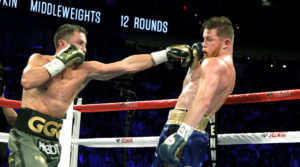
GGG lands a powerful strike on Canelo, who defends with determination.
Gennady Gennadyevich Golovkin a.k.a ‘GGG’
GGG grabs attention with his unique boxing style—a blend of aggression and calm. He conserves energy, unleashing his aggression strategically. When not in attack mode, he’s the picture of composure, landing precise jabs and seamless follow-ups. His work rate is relentless, marked by a continuous flurry of jabs that keeps him in the action.
His exceptional footwork keeps him steady. Even if opponents dodge his jabs, he maintains his balance effortlessly. GGG’s strategic prowess shines through in his ability to control the distance while maintaining forward momentum, a testament to his confidence in range control.
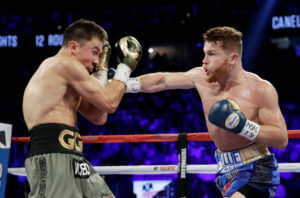
Canelo executes a precise strike against GGG, who effectively blocks the attack.
Canelo Alvarez
Canelo, a true fortress in the ring, resembles a tank with impeccable defense. His hands are perpetually up, forming an impenetrable shield. Renowned for his counter-punching prowess, he’s a master of timing, patiently awaiting the perfect moment to strike. His approach aligns with the “Study, Dominate & Destroy” philosophy. Recall his bout with Amir Khan, where Khan held the lead on points. Canelo’s patience and astute analysis paid off, leading to a fight-ending moment. While not the most active fighter, he exudes calm and steadiness, efficiently conserving energy. When the time is ripe, he deploys a devastating sequence of combinations that leave opponents reeling.
Canelo expertly blocks an oncoming strike from GGG during their match
So, who will you be cheering for in this epic showdown between GGG and Canelo?
As a devoted Canelo Alvarez fan, I’ve always admired his composed approach, advising my own boxer to adopt a similar strategy—stay calm and strike at the opportune moment, just like Canelo does. However, it’s hard to deny that in their first encounter, GGG posed a formidable challenge with his relentless aggression and forward-moving style.
While my gut feeling leans towards GGG potentially dominating this rematch, I’ll still be eagerly tuning in as a loyal Canelo Fan! Let’s all savor the upcoming match, boxing enthusiasts. Enjoy the match, everyone!
As we gear up for the thrilling GGG vs. Canelo 2 bout, it’s clear that this matchup is more than just a fight—it’s a testament to the dedication and skill of these incredible athletes. Whether you’re a fan of GGG’s controlled aggression or Canelo’s tactical brilliance, this rematch promises to be a spectacle.
If you’re eager to start your own boxing journey, check out our Schedule + Rates page. Let’s celebrate the spirit of boxing and enjoy the match together!