Reviving Fitness in Singapore: KOS Gym’s Commitment to Safety
We’ve all been through those frustrating days when life seemed to stand still. For many Singaporeans, especially those devoted to their gym routines, the ‘circuit breaker’ period was a tough challenge. But, the good news is, that phase is now behind us. We’re stepping into the ‘new normal,’ ready to embrace our fitness regimens once more.
The Singapore government has been diligently providing us with the latest updates on the COVID-19 cases that have been impacting our island. It is a sign that we are slowly but surely progressing in our fight against this invisible enemy. As we entered Phase 2 of our post-coronavirus lockdown in June 2020, a sense of hope and relief washed over us as we witnessed the stabilization of COVID-19 infections.
Although travelers entering Singapore may still have to adhere to mandatory stay-home notices, the good news is that businesses within our own borders are now able to reopen and welcome the public back. This means that we can finally return to our beloved gyms and leisure centers, resuming our fitness routines and finding solace in the familiar environment.
At King of Strength (KOS), we fully understand the gravity of the situation at hand. We share the belief that every business has a responsibility to ensure strict measures are in place to protect the health and well-being of our members. This commitment to creating a safe environment for our gym-goers is deeply rooted in our values and principles.
In light of the requirements for safe management measures during this challenging period, we have taken proactive steps at KOS to address the needs of our members. We have thoughtfully prepared a comprehensive set of updates that prioritize the safety and comfort of everyone who walks through our doors.
7 Safety Measures & Updates By KOS
1. Booking System
Keeping each class to just 5 pax with 1 coach/fitness instructor.
To reduce physical interaction that will be more in a larger group setting, decreasing the risk of contracting the coronavirus.
2. Temperature Screening
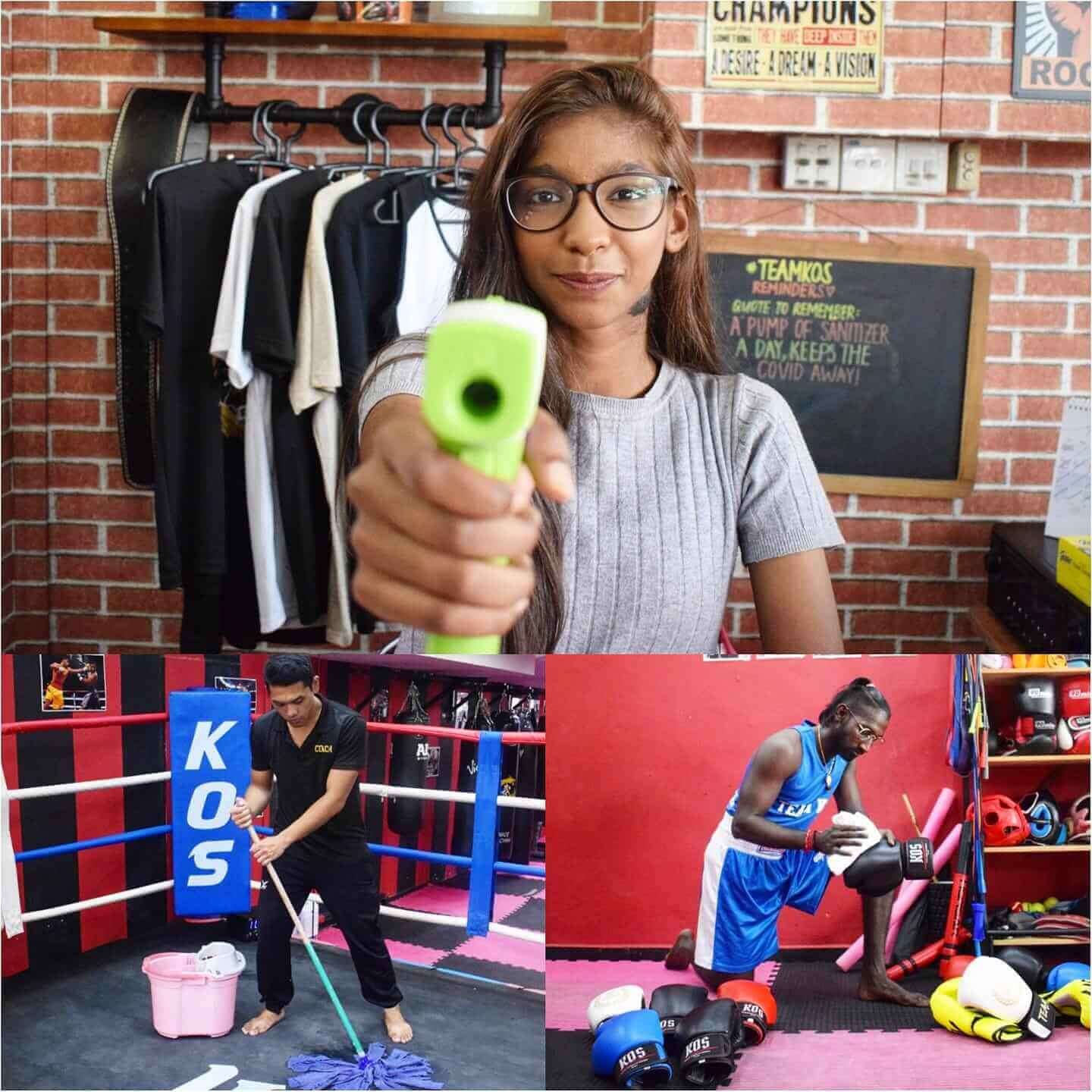
Compulsory temperature taking for everyone including coaches/fitness instructors.
The temperature will be taken for all members upon entry at KOS gym.
High temperature is one of the key symptoms of COVID-19, hence do make sure you are feeling well before arriving at the gym.
3. Sanitizing
Sanitizer is applied to everyone who steps into the gym.
Spray bottles of sanitizers and cloths are kept all around the gym for members to wipe clean gym equipment before and after using it.
Gyms are a hotbed for germs as the sweat of many users gets accumulated on gym equipment.
Sanitizing equipment will reduce the risks of contracting the coronavirus.
4. Safe Distancing Measures
Training is planned in such a way that everyone is at a safe distance from each other.
Punching bags, mitts workout area, etc have been rearranged to be at a safe distance from each other.
This is to ensure that not many people are gathered in a specific location of the gym at any given time.
5. More Classes
From 4 classes per day, we will now be having 6 classes per day, each with a duration of 45 minutes.
Having more classes each day to cater to everyone due to the limitation on class size.
With more classes, there are more timings for members to choose from, promoting flexibility.
6. Online Training
Online training occurs 4 days a week, twice each day.
This is to ensure that members work out regardless of getting a slot at the gym/they are working out from home.
Eg. MINIMUM “3”, RUNNING IS THE KEY, MAXIMUM “3”, ARMstrong Madness, etc.
7. Promotions
KOS has also extended promotions, such as PADWORK of 10 rounds for $45.
Conclusion
While we’ve put in place these crucial safety measures for your well-being, it’s important to understand that they’re not foolproof against COVID-19.
Each one of us carries the responsibility of safeguarding our own health and that of our fellow members. Wear your mask when you’re not actively working out, maintain impeccable personal hygiene, and respect social distancing.
We’re in this together. If the situation continues to improve, we’ll adapt accordingly and keep you informed. For our current schedule and rates, visit our Schedule + Rates page to plan your next safe and rewarding workout.
Home Workout Guide: Achieve Gym-Level Results without Leaving Your Doorstep
When you introduce an extraordinary addition to your life, it has the potential to transform your entire world. It influences your perspective, shifts your priorities, and even molds your daily habits, ultimately affecting how you perceive yourself. So, who is this extraordinary companion? It’s none other than the art of boxing – a combat sport that exudes power and precision, far more than just a physical endeavor.
This article unravels the art of boxing as a means to attain gym-level results right in the comfort of your home. Get ready to explore a practical and down-to-earth guide that will spark your curiosity and leave you eager to continue reading, all while revealing the secrets to achieving your fitness goals without stepping outside your front door.
Boxing Benefits:
Strength:
Physical Strength through endurance testing workouts and mental strength through discipline and focus. It may not make you an absolute lean, mean fighting machine. However, conditioning and body toning will give you the power to deal with nasty bulky wannabes in the world without batting an eyelid. Boxing is a sport where size does not matter, a powerful punch is enough to put down a 7-foot-tall gangster or an animal in self-defense.
Punching Prowess:
Boxing is a stand-up strike style sport. It focuses on building potentially fatal punches. Channeling energy from the entire body to the fist. It is indeed a challenging sport. It works the whole body to perform that one killer move to defeat the opponent.
Burn Calories and Stress:
A person weighing in at 80 kgs may burn 250 calories in 30 minutes by punching a heavy bag. Gradually burning close to 500 calories at the same time as they progress in training. Boxing training is both aerobic and anaerobic in nature, making it an excellent stress reliever.
Boxing enthusiasts in a class, honing their punching skills.
Hectic schedules, time constraints, budget limitations, travel plans, and well many other interruptions lead to missing a workout session at the gym. Buy essential Boxing Wear and Equipment and get started at home instead.
Boxing Gear:
Investing in the right Boxing gear and preparing for your Boxing journey requires a few essentials.
1. Hand Wraps and Training Gloves
Hand wraps protect small bones in the hands from breaking.
It secures the wrists from sprains.
It keeps the skin on the knuckles from tearing
Training gloves or sparring gloves are designed to provide extra protection.
They are heavily padded, compared to professional boxing gloves.
2. Footwear:
Boxing footwear is permeable, allowing sweat to evaporate.
The traction allows you to stand firmly on training surfaces.
They are lighter allowing flexibility of movement.
3. Bodywear:
Intense workouts may lead to skin rashes. It is advised to buy breathable athletic wear.
Women, also, should invest in good sports bras and breast pads for protection.
4. Mouth guard:
Protects the soft tissues in the jawline.
Secures from bone displacement.
5. Jumping rope:
Improves stamina in the forearms, shoulders and leg muscles.
Builds speed-endurance
6. Heavy bag:
Boxing bags range from less than 10 kgs for beginners to 80 kgs for heavy hitters.
It helps you develop power, timing, and rhythm.
A dedicated boxer giving their all during a bag workout.
We compiled a list of exercises that will make you feel no less than going through an intense gym workout without stepping out of your door.
How to exercise at home
Warm-up: Prepare your body for what is to come. 5-10 minutes of slow-paced exercises to avoid sore muscles and chances of injury. Warm-up exercises can get intense once you start training harder.
Beginner – Intermediate – Advanced Training.
Follow a workout routine. No boxing equipment is required. (heavy bags, gloves).
Jog in place to pump up your blood to your muscles.
Jump rope improves heart rate and blood pressure. Strengthens shoulders and arms.
Burpees help work muscles in the entire body.
Mountain climbers raise the heart rate. Build strength and endurance in the core.
Squat Jumps enhance the intensity of your workout, aids in power and mobility.
Use a staircase if possible. In your house or building.
Practice leg swings, arms circling, and torso twists.
Moving forward. Once your body is ready to take on more. Try these Workouts without the heavy bag.
Start with straight punches including back and forth strides.
Switch with hops and jumps.
Build a rhythm, duck, and punch.
Run on the spot with quick big steps.
Work on different Combination punches.
Immerse yourself in intense Shadow boxing.
Finish off your home routine with a conditioning set (low-intensity exercises).
Push-up planks.
Bicycle kicks.
Walking lunges.
V sits & V ups.
Relax. Hydrate.
Hope that was fun.
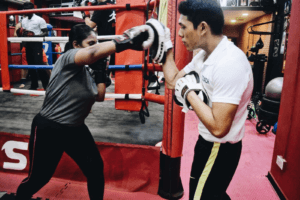
A student diligently training with the guidance of a knowledgeable KOS coach.
In the end, remember that you don’t require a room filled with boxing gear to embark on your fitness journey at home. While gloves, heavy bags, and punch mitts can certainly add excitement to your routine, it’s the training, the camaraderie of sparring, and the motivation you get from a workout partner that truly keeps your spirits high. So why not take that first step towards a healthier, more empowered you?
Whether you decide to join a local boxing gym or opt for personalized boxing training in Singapore, you’ll discover routines tailored to your unique needs. The beauty of boxing is that it lingers in your thoughts long after you’ve left the gym. If you’re ready to make that leap, check out our Schedule + Rates page to find the perfect fit for your journey. Your boxing adventure awaits!
Unlocking the Power of Boxing Workouts: Boost Your Mental Agility and Fitness Beyond the Ring
Curious about the incredible benefits of boxing workouts? Beyond the sweat and exertion, boxing offers a unique path to enhance your mental agility, focus, and coordination. It’s not just about the ring—it’s a real-life skill that can transform your daily routine and help you conquer life’s challenges. If you’re tired of the mundane one-hour gym sessions, it’s time to explore the invigorating world of boxing exercises that will have you coming back for more.
These basic yet effective workouts are accessible to all, offering a thrilling way to ignite your adrenaline and boost your fitness journey. So, let’s dive into the extraordinary world of boxing fitness and discover how it can change your life.
Boxing includes all your basic workouts and more:
Heavy bag
Shadow boxing
Jumping rope
Weight training
Speed bag
Running
Stretching
Heavy Bag:
Start fight training and work your physique and weight loss starts gradually.
Hitting heavy bags builds punching power and increases metabolism. It involves the legs and arms to power up and punch, in turn activating all the parts of your body.
Workout: include legs, knees, and elbows to define your thighs and calves. Work in sets. Combination punches and kicks with shadow boxing or squats for 30-60 seconds. Repeat.
Shadow Boxing:
Shadow boxing helps professionals loosen up joints and warm up before actual drills.
Basic knowledge of punching techniques and footwork can create a shadow boxing workout to aid weight loss. It is like fighting an imaginary opponent.
Workout: Throw combinations, change stance, and work on your hip movements. Shadow Boxing is a package deal.
Mastering the art of cardio – a gym member showcases their rope skipping skills for an effective workout.
Jumping Rope:
We have all at some point had a jumping rope lying at home. Other than tripping over it multiple times. The benefits and yields are humongous.
It is a conditioning exercise.
Continuous jumps and different levels of intensity make it a fantastic workout.
It works the entire body, the swinging action works on the forearms hands, and wrists
The spring and light footwork improves balance, stance, and posture.
Workouts: Shuffle your feet side to side and time yourself. Do a few two-or three-minute rounds, resting 30 to 60 seconds in between. Then proceed to multiple variations like double-unders or two spins per jump.
Building muscle and strength – a gym member working on their weight training routine.
Weight Training:
Weight training improves bone density
It builds lean muscles. Strengthens connective tissues and tendons.
It trains your back and gives you posture.
It reduces stress and enhances the mood.
Workout: Indulge in high and low rep training for optimum results.
To build Muscle and Strength lift lighter weights and do more sets.
To build strength alone, lift heavy weights for a few reps.
Speed Bag:
Improves hand-eye coordination, focus, and punching speed.
It takes immense patience and practice to set a rhythm and work on a speed bag.
Workout: Once you are able to beat a speed bag continuously for over 2 minutes, it can become a part of your complex training.
Running:
Running is a dynamic exercise. There are several variations. Jogging, slow runs, long & short strides, etc.
Running is an intense part of the HIIT training program.
Workout: 5 minutes of warm-up and stretching. Start running at a regular pace for a minute, increasing the speed to your maximum capacity. Keep at it for a minimum of 20 seconds, gradually reduce the pace and slow down. Repeat. Continue for 15 – 20 minutes. Finish the routine with 5 minutes of passive stretching.
Teamwork in action! Our dedicated KOS gym members come together for a challenging plank exercise that strengthens core muscles.
As you contemplate your fitness journey, remember that embracing the world of fight training is simpler than you think. All it takes is your determination, grit, and a burning desire to push your boundaries, alongside the guidance of a skilled coach.
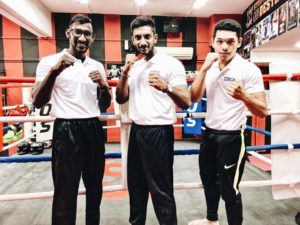
Our dedicated coaching team, from left to right: Coach Krishna, Coach Kumar, and Coach Khai – ready to inspire and train!
At KOS, our dedicated trainers are well-prepared and experienced to assist you in reaching your aspirations. Our mission goes beyond just winning in the ring; it’s about uncovering your true potential, breaking your limitations, and transforming into the best version of yourself.
Ready to take the first step? Explore our Schedule + Rates page and start your empowering journey today
Unlocking the Power Within: How Boxing Elevates Mind and Body
Boxing, with its explosive and powerful nature, offers far-reaching benefits that extend beyond the ring. It’s not just about throwing punches; it’s a holistic approach to harnessing strength and conditioning. In the realm of fitness, the anaerobic style of boxing shines as a versatile contender for a wide range of workouts. But it’s not one-size-fits-all; it’s about crafting routines tailored to your unique physical needs and level of involvement.
In this article, we invite you to delve into the world of boxing and discover the remarkable ways it transforms both your body and mind. The journey to becoming unbreakable, both physically and mentally, is an art that demands unwavering determination, a solid foundation, and the guidance of an exceptional coach. And, as with any significant physical endeavor, it’s wise to consult a doctor before embarking on an intense training program.
Boxing class in full swing, everyone perfecting their punch techniques.
How Boxing works in a nutshell
Provides a comprehensive full-body workout, targeting and toning all major muscle groups.
Strengthens and enhances the core muscles.
Offers valuable self-defense skills within the context of a combat sport.
Alleviates stress, anxiety, and pent-up aggression through the physicality of pounding heavy and speed bags.
As boxing becomes second nature, it becomes convenient to set up home boxing equipment for training.
Acts as an effective high-calorie burner, aiding in weight management.
Enhances the respiratory and muscular systems through anaerobic workouts.
Prioritizes performance and skill development over aesthetic outcomes.
Boosts self-confidence and self-esteem.
Fosters sportsmanship values despite being a combat sport.
Boxing is demanding. To understand how it helps the body in various ways. We have compartmentalized the structure of the sport into four significant phases.
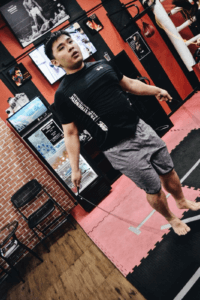
A motivated gym enthusiast skillfully handles skip ropes during their workout.
Phase 1: The Warm-Up.
Think of a warm-up as your essential first step, a friendly introduction before the real workout begins. It might seem gentle, but it’s the secret to making you stronger. Warm-ups consist of functional exercises that gradually limber up your joints and set them in motion. Always begin at a leisurely pace. Avoid passive stretching; save it for your post-workout cool-down. These activation exercises lay the foundation for your technical and strength training
High Knee Walking does not stress the muscles, instead prepares the muscles for intense workouts.
Fast High Knees help pump up the cardiovascular and nervous systems, igniting them for the main workout.
Walking Butt Kicks is reaching out to your butt. It relaxes and knee flexors and the hamstrings.
Sumo Squats release the thigh tension. It works on the core, abdominals, and lower body.
Arm Circles is an upper body warmup to loosen the shoulders, forearms, and hands.
Jumping rope is much more than a warm-up exercise. It builds focus, hand-eye coordination, balance, and agility in footwork.
Boxer Push-ups help strengthen the shoulders and chest
Planks improve balance and help support posture.
Boxer Bicycle Crunches work on the abs, and legs and improve body coordination.
These are just a few exercises to activate your body and fire up your core.
Our skilled and joyful boxer, confidently lifting dumbbells, ready for the ring.
Phase 2: Strength Training
Strength training, sometimes called resistance training, forms the foundation for muscle development and motor skill enhancement. This phase prepares a boxer’s body for more robust, quicker, and more powerful movements. Think of these exercises as functional, performance-focused workouts rather than mere demonstrations. They’re designed to elevate an athlete’s physical capabilities, employing compound exercises that engage multiple joints and muscle groups simultaneously.
Pull-ups work on the posture, back, rear shoulders, and biceps. To give you that vast space so you can take cover from or hit your opponent.
The seated cable row exercise works on the back muscles and forearms.
Triceps Pushdowns are a great way to build muscle and work on the arms. If you have sustained a prior elbow injury, it is suggested you practice under supervision.
Dips are considered superior to push-ups. You lift your entire body weight, unlike pushups. Building body mass and majorly improving your lockout strength.
The Overhead press builds strong arm and shoulder muscles. To shower those iron fists at lightning speeds on the opponent.
Shadow boxing: It may look like throwing punches in the air. However, results depend on the intensity of your workout. Shadow boxing improves boxing skills, overall body fitness, stance, and flexibility.
Sparring: It helps develop speed, control, and defense tactics. Sparring is an essential form of training to help you familiarise yourself with real-life boxing ring situations.
Agility Ladder: This drill can have numerous variations and improves footwork tremendously.
Boxers should also incorporate free weight exercises into their training regimen because boxing is a dynamic and mobile sport.
A determined female boxer demonstrates perfect form during lunges.
Phase 3: Power Training
Power training demands quick and agile movements, but it also comes with a heightened risk of injury. To prepare for power training, you first establish a strong foundation through strength training. The correct technique is crucial at this stage. As you become/ attuned to your body’s rhythm and capabilities, you’ll naturally adapt to the necessary techniques and fluidity. Remember, every move in boxing has a scientific aspect. Engaging in power training elevates your speed, stability, and overall technique to a higher level.
Back squats: They strengthen the lower body. The correct technique where the hips extend and go lower than the knees transfers the force from the feet to the hips, the core, and effectively when you launch up to punch. Back squats maximize the jump in return aiding the impact of your punch.
Clean and Press: Lift as much weight as the body can take retaining its right position. It demands the tightening of the core and back, throughout. Hip extension plays a vital role in balancing the weight of your body. Keep the bar/dumbbells/kettlebells moving except for brief pauses between sets. Squats take power from the ground up to hand, as boxing requires.
Kettlebell Training: Boxing requires ballistic movements. The kettlebell exercises the muscles, their contractions, and speed. The generation of force after training is how boxers pack that powerful punch. Basic movements like one and two-arm swings, clean, press and push presses are essential before moving on to more complex exercises.
Resistance Bands: Core strength is a must for reliable and powerful movements. It helps in rotational exercises.
Here are a few example exercises to incorporate into your routine. The aim of power training is to engage in dynamic exercises that provide your body with a significant power boost without leaving you feeling overly fatigued.
Phase 4: Conditioning
In the boxing ring, maintaining a relentless yet rhythmic pace is crucial. This is where conditioning takes center stage. Conditioning mirrors the demands of an actual boxing match, requiring brief but intense bursts of exercise. While exercises like bench presses, mountain climbers, burpees, and pushups contribute to conditioning, boxing requires a unique approach to fitness.
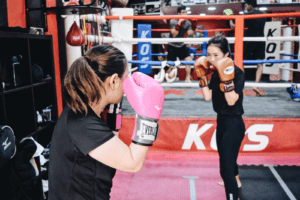
Two fierce female boxers passionately engage in a sparring practice.
Conditioning involves high-intensity interval training (HIIT), a method that fine-tunes your body through anaerobic activities. It consists of swiftly alternating between fast-paced exercises in short bursts, with minimal to no rest in between.
Battle Rope: 30-40 seconds of intense waving works on the upper body. There are multiple variations to use ropes. Take breaks with light footwork and get back in action with flexible arm movements but a firm lower body and core. Repeat.
Heavy bag: Work your punch combinations on the heavy bag for 30-60 with squats after each combo and repeat.
Mix your sets with activities like sprints, leisurely jogs, high-knee jump ropes, and more. Customize your circuits to match your needs and abilities. Notably, shadow boxing stands out as the top choice for interval training, helping you maintain your stance and sharpen your skills.
After intense workouts always remember to relax your muscles to avoid cramps and muscle spasms. Gradually turn to passive stretching for up to 10 seconds to calm the body. These exercises include:
Neck Rotations
Hamstring Stretch
Thigh Stretch
Chest Stretch
Quadriceps stretch
A boxer demonstrates the art of precise and powerful punching.
In the quest for ultimate strength and conditioning through boxing, we’ve unveiled the transformative power of this sport for your body and mind. So, grab a refreshing, calorie-rich drink, and consider joining us at KOS.
Remember, no matter life’s challenges, boxing will always stand by your side, offering its enduring benefits. Curious about our Schedule and Rates? Explore them here and take the next step in your journey with us.
Choosing Between Boxing and Muay Thai: Your Ultimate Guide to Stand-Up Combat Styles
In the world of stand-up combat, two formidable disciplines often steal the spotlight: Boxing and Muay Thai. You may be curious about the similarities and differences between these two striking sports. If you’re pondering which path to take in your martial arts journey, you’re in the right place. This article is your compass to navigate the distinct worlds of Boxing and Muay Thai, helping you make an informed choice that suits your goals and preferences. Let’s explore these fascinating combat styles together, shedding light on their unique characteristics and guiding you toward the one that resonates with you the most.
Boxing
Boxing, which has a rich history dating back to 688BC and originating in Greece, has been practiced for centuries before Muay Thai emerged. Interestingly, Boxing strictly prohibits the utilization of strikes involving knees, elbows, and legs. This martial art relies heavily on footwork, employing defensive techniques such as shoulder rolls, ducks, and slips, along with powerful jabs and hooks, all aimed at gaining victory over one’s opponent.
Muay Thai
Muay Thai, the esteemed National Sport of Thailand, is renowned as “The Art of Eight Limbs.” It embraces a unique approach where eight strategic points of the body are adeptly employed as formidable weapons. With hands emulating the precision of a sword and dagger, the shins and forearms function as protective armor against incoming strikes. The elbow, resembling a formidable hammer, is instrumental in delivering powerful blows to opponents. Moreover, the legs and knees emulate an axe and staff, further expanding the arsenal of this extraordinary combat art. Spanning several centuries, the rich history of Muay Thai contributes to its status as a profound discipline.
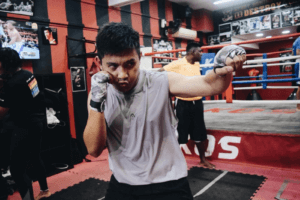
Dedicated KOS Boxer Perfecting Their Punching Technique
Both these styles rising in Singapore. Amateur Training and fights are in demand. It is no surprise; that adults are turning to combat sports to activate their lifestyles. Let’s explore the differences between the two combat styles.
Boxing
Muay Thai
Techniques
Boxing uses hands, wrists, and knuckles to pack powerful punches.
The focus is on the upper body. Boxing trains individuals to skilfully transfer energy from the foot to the fist. It involves mastering footwork and getting the stance right.
Is a more defensive style of sport
Boxing is fast-paced with combinations and swift punches.
The stance is narrow and the distance between opponents is shorter.
Hands are kept close but high, at unequal heights for hand strike and defense.
The side stance reduces the chances of getting hit in the chest, stomach, and hips.
Footwork in boxing is like bobbing to a rhythm. To keep a light foot and balance the body weight for swift, back and forth, and unpredictable movements.
The stance is square with a longer distance among opponents.
Hands are up close and higher with elbows jutting out to attack first.
The square stance offers the fighter an opportunity to strike and counter kicks.
Footwork in Muay Thai is comparatively restricted. It is similar to taking strides. To balance well. The weight of the body is on the back foot, to lean and save oneself from strikes and forward when striking hard.
Self-defense
Boxing may seem like a brutal sport. Instead, it turns out to be a self-defense style as compared to other combat sports.
Duck, slip, bob, shoulder roll punches, parry and block punches, clinching, the side stance, and circling the opponent are all, in fact, part of defensive moves.
Muay Thai is majorly an offensive combat style. Fighters do not dodge, instead, they only block.
For defense, they lean back or step away. They clinch, not to pause, but to knee the midsection.
Blocking punches with forearms and kicks with shins. These tactics absorb the attacks only to give them back with more power.
Body workout
Though Boxing needs the upper body. The workout involves the entire body training. Boxing intensely strengthens the shoulders arms and back. However, the sport takes power from the feet to the hand, thus turning it into a full body workout making you sweat those fats like water.
Muay Thai works on every muscle of the body. It is a blend of cardio, strength, conditioning, and endurance training. It gives your body definition. Makes your shins as tough as iron. Turns your elbows and knees into rock-solid armor. It is indeed a high-intensity fat-burning workout.
KOS Boxer Receives Coach’s Instruction on Punching Form
When it comes to choosing between Boxing and Muay Thai, you’re not just selecting a sport; you’re embracing a way of life. Boxing hones your punching finesse, while Muay Thai offers the advantage of devastating kicks. It’s a captivating dance of two distinct worlds, each with its unique strengths. Remember, you don’t have to pick just one – integrating both styles into your training can make you a well-rounded fighter. Whether you’re a budding boxer or aspiring Muay Thai expert, the journey begins with the right instructor.
At KOS, we’re more than trainers; we’re your partners on this martial arts journey. Discover your path, explore your potential, and schedule your training with us today on our Schedule + Rates page.
Unlocking the Secrets of Martial Arts: Choosing the Perfect Combat Sport for You
In the realm of martial arts, the name itself carries a formidable weight, capable of humbling even the most presumptuous. Yet, it’s not merely about combat, nor simply the art of defeating an opponent. Instead, it embodies a systematic and methodical approach to combat, encompassing a rich tapestry of styles. Mixed Martial Arts (MMA) stands as a testament to the hybridization of these combat forms. Some sports boast a profound history, while others blend various styles in the modern era. Each discipline, however, boasts its distinctive philosophy of combat.
But here’s the truth: there is no superior martial art form. As the legendary Bruce Lee once wisely noted, “I fear not the man who has practiced 10,000 kicks once, but I fear the man who has practiced one kick 10,000 times.”
So, how do you choose the right combat sport for you?
Dedicated KOS gym members honing their boxing stances.
Physical Conditions:
Some styles are Aerobic while others are Anaerobic. All sports demand a certain level of physical fitness. It is recommended to join a gym or training session to avoid risk or injury. Indulge in warm-ups and basic exercises to allow your body to get comfortable with high-intensity workouts.
Contact Level:
Combat sports offer non-contact options, but the level of involvement varies. If you have prior injuries, their severity can be a concern. We advise consulting a certified gym trainer or a doctor before embarking on any program to address any inhibitions or fears of potential injuries, whether minor or major. For those seeking a path to recovery, Changi Sports Medical Centre specializes in helping individuals heal from sports injuries faster and return to their former strength and abilities.
Purpose:
The purpose of picking up skills in a combat sport resonates with learning it. Leisure, relaxation, conditioning, endurance, self-defense, or weight loss. These disciplines are renowned for their effective methods and techniques, empowering you to navigate and diffuse conflict in challenging situations.
A sport:
If a Martial Arts program is a sport for you, some gyms train in no contact or mild contact programs. They follow similar workouts and training sessions, warms up and routines.
Two skilled female boxers engaged in a sparring match.
Combat Sports are divided into 6 categories to help you make a better choice.
What sport to choose?
Sport
Combat Style
Characteristics
1
Boxing
Kickboxing
Muay Thai
Tae Kwon Do
Capoeira
Karate
Taekwondo
Krav Maga
Kung Fu
Tang Soo Do
Wing Chun
Striking or Stand-Up Styles
These unarmed combat sports focus on defending oneself on their feet by using blocks, kicks, punches, knees, and elbows.
2
Brazilian Jiu-Jitsu
Jujutsu
Wrestling
Catch Wrestling
Sumo
Grappling or Ground Fighting Styles
These Combat Arts focuses on taking opponents to the ground, achieving a dominant position or utilizing a submission hold until the end of the fight. It includes utilizing joint locks and chokes hold to their advantage.
3
Judo
Aikido,
Hapkido,
Shuai Jiao
Throwing or Takedown Styles
A more vigorous Combat style. These closely overlap the grappling style. The fight starts off with a standing position. Proceeding to throw and take down the opponent to the ground.
4
Tai Chi
Baguazhang
Chi Gong (Qigong)
Low Impact or Meditative Styles
Low-impact styles of martial arts were once used for combat and still can be. However, nowadays the movements are helpful with breathing techniques and fitness. Seniors in Singapore prefer to indulge in these styles.
5
Iaido
Kali
Kendo
Fencing
Weapon Based Styles
There is an addition of weapons in these combat sports – swords, sticks, wooden staffs.
6
MMA
Jeet Kune Do
Ninjutsu
Shootfighting
Hybrid Styles
These Martial Arts styles use mixed techniques. Mixed Martial Arts is slowly popularising through the Ultimate Fighting Championship (UFC) and Singapore Fighting Championship (SFC).
UFC & SFC
The Ultimate Fighting Championship (UFC)was established in 1993 as a professional mixed martial arts (MMA) organization in the United States of America. The organization hosted competitions to determine the most effective Martial Arts for unarmed combat. Gradually competitors started training in different styles to become all-rounders. Fighters blended their skills, and the style came to be known as MMA (Mixed Martial Arts). Every year, the UFC hosts over 40 fight events worldwide.
The Singapore Fighting Championship (SFC) hosted its sixth installment in September 2017. The event saw over 20 matches from multiple fighting disciplines including professional boxing, MMA on top of a slew of amateur fights. It encourages to promote and support local as well as foreign fighters.
Hole in the pocket?
KOS Members Ready for Action
At fight gyms across Singapore, you’ll find a range of programs to fit your budget, typically between $170 to $250 per month. Whether you’re interested in technical training, personalized coaching, or even programs for kids, there are options for everyone. Consider checking out KOS, a vibrant gym in North Singapore, offering affordable boxing programs suitable for all ages, from kids to seniors. You can bring your gear, or if you prefer convenience, KOS provides the essentials.
Ready to take the plunge? Join us and discover the transformative power of combat sports. Visit our Schedule + Rates page for more details.
Unlocking the Secrets of MMA: Exploring the World of Boxing and Kickboxing
Curious about MMA? Mixed Martial Arts (MMA) isn’t just a single sport; it is made up of Boxing, Kickboxing, Muay Thai, Brazilian Jiu-Jitsu, and Judo.
Boxing, with its roots dating back to 688 BC in Greece, has evolved significantly over the centuries, shaping the modern combat sport we know today. In contrast, Kickboxing, a relative newcomer, traces its origins to Thailand, drawing inspiration from Muay Thai and Karate.
So, whether you’re a seasoned fighter or just someone with a curious spirit, join us as we delve into the facts, advantages, and disadvantages of Boxing and Kickboxing together!
BOXING
Boxing is an energetic and rugged sport. It often leaves both the winner and the opponent with bruises and injuries. However, the real beauty of boxing lies in the transformation it brings to your body and mind. The enhanced stamina, endurance, and focus you gain through training are truly unmatched. If the intensity of the ring seems daunting, non-contact boxing offers equally valuable benefits.
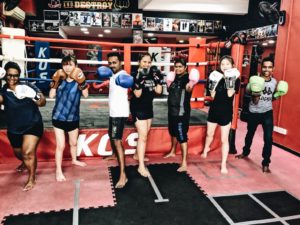
Strength in numbers! Our class putting in the work with powerful punches.
KICKBOXING
Kickboxing, a fusion of Thai Boxing and Karate, stands as a unique sport. It incorporates a combination of kicks and punches, making it more susceptible to vulnerability compared to traditional boxing. Unlike Boxing, Kickboxing introduces elements like knees, elbows, and powerful kicks, creating a challenging environment for defense.
Boxing & Kickboxing
Boxing
Kickboxing
Function
Boxing revolves around delivering powerful punches, primarily using the upper body.
But, the power starts from your feet, traveling up to your knuckles as you unleash a devastating punch.
It emphasizes agility in footwork, head movement, circling, sparring, and, most importantly, the synergy between mind and body.
Engaging in boxing is an exceptional way to burn calories.
Kickboxing offers a high-intensity cardiovascular workout.
As a martial arts discipline, it brings an array of health benefits. The combination of kicking and punching enhances balance and strengthens the entire body.
With a greater potential for strikes, kickboxing keeps fighters on high alert in the ring.
Moreover, it outperforms boxing when it comes to calorie burn.
Body workout
Works the upper body muscles (trapezius, deltoids, biceps, triceps, shoulders, abs, chest, and back).
Works the lower body muscles: Quadriceps, hamstrings, and glutes.
Utilizes all these muscles for punches, evasion, and defensive moves.
Relies heavily on the respiratory system for stamina during this intense, anaerobic activity.
Enhances conditioning and skills for maximum effectiveness against opponents or heavy bags.
Encompasses a full-body workout.
Offers benefits such as reduced body fat, improved flexibility, and a stronger cardiovascular system.
Emphasizes the need for proper warm-ups due to its high-intensity nature.
Self – Defense
Boxers primarily focus on training with their hands.
Developing focus and speed can lead to more impactful punches.
In the boxing ring, opponents tend to stay in close proximity since the sport limits strikes to punches above the belt. This close range can provide a defensive advantage.
In contrast to Boxing, Kickboxing maintains a greater distance between fighters, as the potential for unexpected kicks is higher
Kickboxing isn’t traditionally categorized as a defense-oriented sport.
Kickboxing tends to have a higher injury rate compared to Boxing.
Technique
In boxing, fighters typically stand sideways. This sideways stance reduces the target area for opponents to land punches and keeps them unpredictable.
The most effective defensive maneuver in boxing is to duck down and evade incoming punches.
Kickboxers usually adopt a square stance. This square position allows them to be ready to defend against both kicks and punches.
Stepping back or ducking to dodge punches in kickboxing can expose a fighter to the risk of a powerful hip-rotating kick from their opponent.
Body Type
Don’t be misled by the idea that taller or bulkier fighters always have the advantage in Boxing. In this sport, each body type has its unique strengths.
Take Manny Pacquiao, for instance; despite being 1.66m tall, his big bone structure and 8-inch wrists give him a significant edge.
In Kickboxing, leg kicks are a dominant technique, making powerful lower body muscles essential. If you’ve had previous injuries, it’s wise to undergo a fitness check before diving into Kickboxing.
Regardless of your body type, speed and endurance are crucial attributes for success in Kickboxing.
Consider following the example of Buakaw Banchamek, a renowned 1.74m tall Muay Thai Kickboxer, to hone your skills in the art of Kickboxing.
Stress Reliever
Boxing is both a physical and psychological activity. In our busy, sometimes monotonous lives, stress can pile up. That’s where jabbing combinations on a heavy bag come in. It’s an effective way to release frustration, ease anxiety, and channel aggression.
For those moments when you’ve had a tough day at work or just need an outlet for pent-up energy, Kickboxing is a fantastic option. The act of punching and kicking bags can help reduce anxiety and bring a sense of calm to your mind.
Precision and technique matter. Practice makes perfect at KOS Boxing Gym.
In these challenging times, we believe that it’s never too late to begin your fitness journey. Amidst the chaos of daily life, a simple gym routine might not suffice. At KOS, we’re not just offering you a chance to learn Boxing; we’re inviting you to embark on an experience that transcends the confines of the gym. It’s about discovering the discipline, strength, and mental clarity that Boxing brings to your life. So, why wait?
Take the first step today. Visit our Schedule + Rates page and start your transformative journey with KOS.
Elevate Your Life: Discover 12 Premier Fight Gyms in Singapore
In today’s fast-paced world, life can often become a whirlwind of stress and exhaustion. But have you ever considered that learning a combat skill could be the antidote to this chaos? It’s not just about self-discipline; it’s about gaining the confidence to conquer any challenge life throws your way. More importantly, it’s about the art of self-defense, a skill that can directly enhance the quality of your personal and professional life. Now, you might be wondering if you have the dedication for such training. Well, here’s the truth: combat styles are far from your average gym workout. They’re tailored to your unique body type and commitment level.
At KOS, we pride ourselves as Boxing Masters, but we don’t stop there. We understand the world of hybrid combat sports and have crafted our training routines to offer you the very best of boxing and its contemporaries.
Combat sports, you see, is a vast universe filled with different genres and an infinite array of combat styles. Some have stood the test of time for centuries, while others have evolved over a few hundred years. Engaging in martial arts is an exceptional journey, one that doesn’t waste a single hour of your precious time; instead, it transforms your entire lifestyle.
So, why should you consider embracing a combat sport, and where can you find the right training? Stick with us as we explore the answers.
Experience the dedication and hard work at KOS Gym during our training sessions.
A quick guide to Fight Gyms you can train in Singapore
Combat sports can broadly be divided into 6 categories.
1. Striking or Stand-Up Styles:
These unarmed combat sports focus on defending oneself on their feet by using blocks, kicks, punches, knees, and elbows.
2. Grappling or Ground Fighting Styles:
These Combat Arts focus on taking opponents to the ground, achieving a dominant position, or utilizing a submission hold until the end of the fight.
3. Throwing or Takedown Styles:
A more vigorous Combat style. It overlaps the grappling style. The fight starts with a standing position and proceeds to throw the opponent to the ground.
4. Low Impact or Meditative Styles:
Low-impact styles of martial arts are helpful with breathing techniques and fitness.
5. Weapon Based Styles:
There is an addition of weapons in these combat sports – swords, sticks, and wooden staffs.
6. Hybrid Styles:
Hybrid Styles are an amalgamation of multiple combat disciplines. It is a modern and evolving form of unarmed combat.
Our skilled coaches at KOS Gym are here to help you refine your boxing techniques.
Let us explore the most popular combat styles locally practiced at Fight Gyms and why.
1. Boxing
Combat style
Striking or Stand-Up Style
What is Boxing?
Boxing is an unarmed combat sport. It involves weight loss, and improves balance and coordination. Increases focus, instills confidence, and develops self-defense skills. It is among the most popular Martial Arts sports to be practiced locally. Boxing provides a holistic approach to fitness and health with different training phases that suit your body type and physical capabilities.
How to train
Boxing workouts are split over days and weeks. Workouts include Strength training, Power training, and Conditioning that blend multiple aerobic and anaerobic exercises. An actual game of iron fists, boxing, works on the legs muscles, core, and the entire upper body.
Where
There are several Boxing Gyms in Singapore to develop Pugilism skills.
A compact and vibrant red and black space define the community that boxing has created. Sweaty fighters, hardworking adults and shadow boxing kids, this gym trains one and all. Experienced coaches develop great routines to break you down till it makes you strong!
Located in the CBD with experienced trainers available at all times to suit your schedules is an excellent option if you need to take a short break from work.
It is an urban, industrial vibe boxing community. The Ring has an in-house juice bar to hydrate your dying body and give it a protein boost after killer workouts!
Muay Thai originated in Thailand several hundred years ago. This combat form uses kicking, punching, elbows, and knees and clinches. Traditional techniques like hammer fists, backfists, palm strikes are allowed.
Kickboxing is an amalgamation of a few stand-up combat styles like Karate and Boxing. A comparatively modern sport, Kickboxing is practiced for self-defense and to enhance the general health and fitness of an individual.
How to train
Muay Thai and kickboxing involves intense aerobic exercises. It trains in drills and punch-kick combos on Thai pads. Once you master the strikes, the training advances to intense sparring. An essential before you set foot in the ring. Sparring works on your power and core endurance. MMA fighters train in Muay Thai to diversify their strikes and keep them flexible. It works on the upper and lower body. Sculpts the thighs and shins allowing them to take dangerous blows.
Located in 4 locations islandwide. One of the best Martial Arts fights gyms in Singapore. Known for its Muay Thai training, the gym boasts a list of skilled and experienced practitioners.
They provide training in basic, intermediate and advanced Muay Thai training. They allow self-training with a minimal membership fee for experienced enthusiasts as well.
There are seven training centers located across Singapore. A membership here guarantees access to world-class training equipment and professional facilities. With trial classes starting at a mere $15, it is worth it.
3. Taekwondo
Combat style
Striking or Stand up Style.
What is Taekwondo?
Tae (foot), Kwon (hand), Do (art) is recognized as one of the oldest forms of Martial Arts. This self-defense combat sport originated in Korea. It is one of the most practiced Martial Arts form worldwide. It is also an official Olympic Sport.
How to train
Taekwondo training vary according to ranks and belts. The perseverance and commitment to learning this combat style are unlike any other. Not only does it take years to master, but the belts give one a sense of achievement as they advance. The combat style includes various drills and lots of sparring. This sport trains in relaxation techniques, cardiovascular exercises, and the ever-popular brick-breaking tactics!
The academy was established in 2010. They start training programs for children aged 2 years and above. It focuses on developing competitors and encourages participation in several competitions.
Singapore Taekwondo Academy,
Clubs are at 5 locations islandwide. Dedicated masters and instructors teach traditional Taekwondo. Students range from 6 to 60 years of age.
4. Brazilian Jiu-Jitsu
Combat style
Grappling or Ground Fighting Style
What is BJJ?
The unarmed Martial Arts form is born from the ground techniques of Judo. The techniques are built on the idea of how larger and stronger opponents can be tackled and defeated through the right BJJ methods and bodymechanics. This combat sport does not involve punching and kicking.
How to train
Unlike other Martial Arts, BJJ warms up with intense cardio exercises like jumping jacks, burpees, and gymnastic style workouts. It allows the body to get into a rhythm and gain flexibility for strength training. The next focus is on techniques that take years to master and deem to be excellent workouts. Rolling, drills, and sparring are the main course of BJJ training. It is a life-changing Martial Art form.
BJJ Singapore is equipped with all kinds of Strength and Conditioning equipment. It is the first and longest running BJJ Academy in Singapore.
Gracie Barra Singapore
Located near the CBD is dedicated solely to BJJ training. The instructors are said to be pioneers of introducing the Combat Art to the Lion city.
Evolve MMA, is an expert at multiple Martial Arts forms. Muay Thai, BJJ, Wrestling, MMA.
5. Judo
Combat style
Throwing or Takedown Style
What is Judo?
Judo originated in Japan. The motive of the sport is to throw the opponent to the ground by creating an imbalance to immobilize and make them submit though joint locking the elbow or by applying a choke. The strategy focuses on both standing and ground combat. Judo, like BJJ, is also an Olympic Sport.
How to train
Judo includes numerous variations in rolls, falls, throws, hold downs, chokes, joint-locks, and strikes. Standing combat includes hand, hip and foot and leg techniques. Ground fighting combat includes joint locks, strangleholds, and pinning techniques. Depending on the technique, one is required to undergo different strength and condition training. They all train you in speed, stamina, strength, flexibility and focus at different levels. Stretching is considered to be a critical aspect of training in Judo.
The academy is located across 3 locations islandwide. It believes in Strength through Compassion. Instructors hail from all aspects of the Combat sport. From experienced masters to seasoned competitors. They hold different programs for adults and children who learn and those are interested in competitions.
SA Judo Academy.
The Academy has 5 clubs across Singapore. The founder is SEA Games gold medalist Mr. Tang Soon Onn. He firmly believes in the spiritual and physical benefits of Judo. The SA Judo Academy shares the benefits and promotes the sport to all Singaporeans.
6. Tai Chi
Combat style
Low Impact or Meditative Style
What is Tai Chi?
Tai Chi is a slow and gentle sport. It does not leave one breathless. Practiced by seniors in Singapore; its key components of fitness include muscle strength, flexibility, core stability and aerobic conditioning. Regular practice of Tai Chi helps improve posture and balance.
Karate comes from the island of Japan. Karate means Empty Hand, unarmed fighting. Its foundation is based on two themes, self-defense, and fighting. This combat art seeks to discipline and persistence in training. Such that, it becomes a way of life. It believes in the ‘never attack the first rule.’
How to train
Karate does not require bodybuilding. Strength and Weight training is crucial for the sport to increase flexibility and endurance power. Karate focuses on exercises that involve the entire body to work as a single unit. An experienced Karate instructor observes how you follow physical routines and determine functional exercises accordingly. The exercises focus on core building, movement and motor patterns rather than muscle building.
Established in the early 60’s. It is deemed as the oldest and most valuable karate training centers in Singapore.
JKA Singapore, Jellicoe Rd.
The Japan Karate Association has its Headquarters in Japan. They are dedicated to teaching traditional Karate to locals and including contemporary values to make training more enjoyable.
8. Wrestling
Combat style
Grappling or Ground Fighting Style
What is Wrestling?
Wrestling is unlike what you see on television. It is one of the oldest combat sports in the world. This unarmed full contact combat is unique. To succeed one requires a deep understanding of Sports Biomechanics.
How to train
Wrestling involves intense body training. Training includes Warm-up, stretching, strength, aerobic and anaerobic training. This works on stamina, strength and balancing techniques. Wrestling firmly emphasizes on age-appropriate training.
They train adults and kids across several clubs islandwide. The association has produced multiple professional fighters.
9. Fencing
Combat style
Weapon Based Styles
What is Fencing?
Fencing is an organized combat sport. It is believed to have originated in Spain. It is a blend of elegance, mental endurance, and physical speed. Fencing is like a graceful beauty in comparison to its other Martial Arts counterparts.
How to train
Fencing does not have a high rate of physical injuries. Although muscle imbalances, injuries to the knee, hip, Achilles heel and the back can occur. The sport consists of movements. Advances, retreats, lunges, and leg leads.
Therefore, Fencing includes agility and core training. Performance enhancing activities, balance, and posture improving exercises. Fencers dedicate time to meditation to focus on their bodies and reflexes.
Where
Locally, it is not very popular. However, there are various fencing training classes across Singapore. ActiveSg promptly supports Fencing.
Z Fencing, Thompson Road.
It features 3 pistes for fencers to fence and conducts classes for children as young as four years old.
Fencing Masters, Ubi.
Trainings are held by highly certified fencing masters. The Master Head Coach Mr. Jeffrey has more than 42 years of experience in the sport of fencing. He is a double Silver medallist & Bronze medallist at the South East Asian Games (SEA Games) in 1987 for Singapore.
10. MMA
Combat style
Hybrid Style
What is MMA?
Mixed Martial Arts is a versatile and modern unarmed full body combat sport. MMA blends Boxing, Muay Thai, Brazilian Jiu-Jitsu, Judo, and Wrestling techniques.
How to train
There are infinite workouts and routines. For example, a basic training may include squats, deadlifts, bench presses, and power cleans combined with sprinting and stretching. Intense and strenuous physical, strength, power, and conditioning training makes an MMA fighter.
Where
A few renowned fighting gyms across Singapore train in MMA and the other combat sports mentioned above as well. They also offer MMA trails.
This gym has produced many homegrown local fighters including Singapore’s first and only UFC fighter. They provide affordable training. Trainers include experienced MMA fighters and champions.
We’ve covered a lot of ground in this extensive article, and we hope it’s been an insightful journey for you. At KOS, we’re not just experts; we’re passionate combat sports enthusiasts and Boxing masters. So, if you’re ready to take that first step towards self-discipline, confidence, and a transformative experience, don’t hesitate any longer.
Join us for fight training, and discover how our gym can become your new sanctuary. Ready to get started? Check out our Schedule + Rates page now and let’s make it happen together.
Unboxing the Reality: Debunking the Myths and Risks of Boxing
Although boxing is considered safer than activities such as horse riding, scuba diving, and gymnastics, it often carries an intimidating visual imagery. Notably, certain countries, including Norway, Cuba, and North Korea, have even prohibited professional boxing. Comparatively, sports like soccer and cricket may appear effortless, yet they do carry the risk of fractures, ankle sprains, ligament damage, as well as head and neck injuries. So without a doubt, boxing has the potential to cause both minor and major injuries.
The Common Myths
1. Boxing is a Dangerous Game
Boxing is not a game, but rather a combat sport. It involves adhering to a set of rules where the outcome is determined by an individual’s performance. To prioritize safety, the Amateur Boxing Association has implemented stringent guidelines that require rigorous physical, mental, and medical tests conducted by experts before each match.
2. Boxing is two people punching to kill
While a first-time spectator may have preconceived notions, boxing is a multifaceted sport. Before stepping into the ring, fighters diligently prepare themselves by studying their opponents’ weaknesses and capitalizing on their strengths. It is a strategic contest, akin to an exam, where the more proficient athlete emerges victorious. In cases of significant blows or injuries, the referee promptly intervenes, and the scoring system determines the outcome.
3. Boxers pick fights
Boxers indeed engage in fights, but only in the context of self-defense. Through training, they develop self-confidence and clarity. Their ultimate goal is to avoid confrontations by utilizing defensive techniques such as blocks, ducks, rolls, and agile footwork to effectively evade any potential assailant. Punches are employed as a last resort, serving as a reminder that righteousness prevails over evil.
Intense training session as one boxer strikes while the other defends.
Common Boxing Injuries:
Fractures can affect the bones in the hand that connect the wrist to the fingers. Fractures in the nose, jaw, and ribs are also occasionally observed.
Cuts and bruises are a common occurrence and can happen anywhere on the body. In amateur boxing, cuts are rare due to the use of protective headgear, but they are more prevalent at professional levels. Once a wound has been properly cleaned and covered, it will heal.
Concussions can result from a severe blow to the head, causing the brain to move within the skull. They are considered as one of the most serious injuries in contact sports, often leading to a state of confusion or disorientation.
Dislocated shoulder, when promptly treated, poses fewer risks. Adequate rest for several weeks is essential for its healing process.
Precautions
In October 2017, bodybuilder Pradip Subramanian’s sudden death due to cardiac arrest in a celebrity Muay Thai fight hit the news. Thereafter, stringent actions were taken to regulate medical assessments of fighters before fights.
To minimize the likelihood of sports-related injuries, it is essential to educate oneself on the potential risks and adhere to safety guidelines. Specifically, in the context of boxing, it is important to familiarize oneself with proper techniques and follow safety tips. Additionally, ensuring the correct usage of headgear, mouth guard, hand bandages, and boxing gloves is crucial.
Boxing class gets ready for action with a plank warm-up.
Boxing is for everyone
Boxing is an inclusive activity that caters to individuals of all genders and ages. In today’s modern world, we face various pressures such as long work hours, family challenges, stress, and depression. Engaging in martial arts provides an opportunity for interactive and holistic self-care, offering a refreshing alternative to mundane gym routines. As long as there are no significant injuries, anyone from the age of 19 to 91 can participate and enjoy boxing.
For men, boxing offers a chance to take a break from demanding schedules and embrace the sport to enhance their overall fitness. Singapore is home to numerous boxing gyms, where men can connect with like-minded individuals and push themselves to achieve their best physical shape. Fathers can benefit from obtaining a fit and healthy physique, becoming role models for their children, and emphasizing the importance of health and well-being.
For women, boxing presents an opportunity to shed societal expectations and empower themselves through basic self-defense techniques. Learning these skills, alongside maintaining physical fitness, can contribute to personal safety and confidence in challenging situations. Additionally, boxing is beneficial in managing conditions such as postpartum depression, allowing women to be the mothers they aspire to be and the women they believe they can be.
For children, the early years of life establish the groundwork for their future. Encouraging children to participate in boxing helps them develop and cultivate healthy interpersonal and physical skills. Equipping them with self-defense abilities enables them to feel secure and confident in vulnerable situations. Boxing techniques foster eye-hand coordination, presence of mind, critical thinking, and quick responses, which aid in managing school-related stress and improving performance.
Guy practicing defensive boxing moves
Physical and Psychological benefits
Boxing offers a range of advantages for both the body and the mind. It promotes the development of strong muscles, which are essential for supporting the bone structure. Additionally, it provides an excellent cardiovascular workout that greatly benefits the heart. Moreover, boxing has been shown to help prevent conditions such as high blood pressure, high cholesterol, and diabetes.
It is worth noting that boxing is not a skill that can be acquired overnight. It demands significant commitment and years of training to truly master the sport. Nonetheless, individuals have the freedom to choose their level of involvement, whether it be for recreational purposes or a more serious pursuit.
It is widely acknowledged that a healthy heart is the cornerstone of a healthy body and mind. Boxing goes beyond just physical combat and is considered an art that can enhance an individual’s ability to resolve conflicts, both in the physical sense and in the realm of the mind.
Discovering the truth about boxing may have put some doubts to rest, but curiosity often leads to courage. If you’re no longer afraid and ready to step into the ring of this remarkable sport, KOS welcomes you with open arms. Our passionate coaches are here to make your journey enjoyable and safe. It’s time to experience the many benefits of boxing for yourself.
Let’s take the first step together. Book your free trial at KOS today and uncover a world of fitness, self-discovery, and empowerment that awaits you.
Achieving Boxing Mastery: Essential Equipment and Training Regimens for 10 Days
In the fast-paced world we live in, time is a precious commodity, and we’re all racing against the clock. With everything just a click away, it’s tempting to seek quick fixes and shortcuts in our pursuits.
However, some endeavors, like mastering the art of boxing, demand more than just a shortcut. They require time, passion, and unwavering dedication. Just like any other skill or art form, boxing demands constant practice, relentless perseverance, and yes, time. It’s an Anaerobic Sport that thrives on exceptional intensity and unwavering focus during training. Yet, one of the biggest challenges we face on our journey to boxing excellence is the limited time we can spend in the gym.
As humans, we naturally crave rapid progress, but it’s crucial to understand that learning and mastering are two entirely distinct endeavors. Along the way, you’ll encounter challenges and mental blocks, but remember, there are no shortcuts to real training success. So, let’s explore the key elements that can help you optimize your boxing journey.
Coach Kumar trains a dedicated boxer in dodge techniques.
Which Boxing Equipment do you need?
To kickstart your 10-day boxing journey, having the right equipment is essential. Here’s the list to enhance your performance and make the most of your training.
Boxing Gloves
One of the must-have items in your training gear collection is a set of training gloves. These gloves are fantastic for all kinds of training activities like bag work, mitt work, and even live sparring sessions. Training gloves come in various sizes, typically ranging from 10oz to 16oz.
Weight
Glove
80 kgs or heavier
16 oz
67 kgs – 80 kgs
14 oz
67 kgs or lighter
12 oz
Children (6-12 years)
8 oz
Hand Wraps
Hand wraps are important especially when it comes to safety. They’re essential for anyone who trains in boxing or martial arts. These handy wraps are designed to protect your wrists from sprains and, even worse, breaks when you throw a powerful punch. Not only that, but they also keep the skin on your knuckles from getting torn up when you’re going hard on those heavy bags.
Head Gear
Consider investing in a decent sparring headgear. The padded helmet is essential for boxers who indulge in live sparring. The headgear will effectively protect against cuts, swelling, and bruises.
Mouth Guard
Get yourself a mouth guard once you start your boxing journey. It comes in handy during sparring and drills. The mouth guard is used to prevent or decrease the chances of injury to the teeth, arches, lips, and gums.
Footwear
Boxing shoes are lightweight and have a nice, soft sole design that lets you move around quickly. They’re perfect for keeping your feet dry since sweat dries up in no time. Plus, they offer great traction for your training surface.
Training solo at home
And, if you will be training at home, make sure to add these to your list.
Punching Mittens
Boxing Body Protector
Heavy Bag
Establishing effective routines to condition your body is essential for your boxing journey. Consider incorporating self-help YouTube videos into your training arsenal. But remember, balance is key.
Don’t push your body to its limits every day. Instead, maintain a mindful approach by monitoring the intensity, frequency, and volume of your workouts. Discover what suits you best, and alternate between intense training days and lighter ones. Pay close attention to your movements as you punch and move, constantly refining your technique. This approach ensures steady progress in your boxing journey.
A boxer dodges a powerful attack during an intense sparring session.
Learn boxing in 10 days
Scientific advancements have truly enhanced our knowledge of the human anatomy, allowing us to make well-informed decisions regarding our bodies. With that in mind, KOS presents an excellent solution – a compact Boxing training program crafted specifically to accelerate your skill development in a mere 10 days.
However, it’s important to bear in mind the saying: “No pain, no gain.”
Day 1.
Introduction and Footwork
Get to know your gym trainer, understand safety rules, and familiarize yourself with boxing equipment.
Work on your stance and footwork: Stand-up Base, Cross Footwork, and Circling.
Learn about foot placement, positioning, body angles, and weight distribution for better performance.
Day 2.
Punches
Understand the basics of boxing punches.
Master straight punches, jabs, the right cross, and the 1-2 combination.
y 3.
Curved Punches
Explore the art of dynamic boxing.
Delve into combinations, hooks, uppercuts, and body shots
Day 4.
Defense
Learn essential defense techniques.
Practice blocking, parrying, high and low front cover, rolling, and slipping for solid defensive skills.
Day 5.
Advanced Defense
Enhance your defensive arsenal with head movements, neck pulls, and ducking techniques.
Develop arm and hip balance, master torso tilting, and perfect squat planting for an impenetrable defense.
Maximize your performance by honing your timing and focus.
Day 8.
Advanced Skills
Elevate your punching skills and delve into advanced counter-punching and defense techniques.
Gain valuable insights into enhancing your speed, strength, stamina, balance, and reflexes with expert tips and guidance.
Day 9.
Boxing Training
Tailored workout plans that suit your needs best.
Follow specialized Routines to develop your conditioning and overall performance.
Day 10.
Sparring
Engage in sparring drills and sharpen your skills through shadow boxing.
Gain valuable insights into fight tips and strategic approaches to elevate your boxing game.
Congratulations to you if you’re up for the challenge of going for the eleventh day!
Boxing is truly an incredible sport. The continuous act of throwing punches, maintaining focus, and finding balance is no easy feat. Whether you’ve been at it for 10 days, 30 days, or even a year, there’s always more to learn and discover. The key is to keep improving.
Our boxing classes are always buzzing with energy and enthusiasm here at King of Strength Boxing Gym.
At KOS, we’re dedicated to nurturing not only your physical prowess but also your mental fortitude. Our philosophy revolves around helping you become the best version of yourself, both in and out of the boxing ring.
Take just 15 minutes each day to mentally rehearse your boxing moves, embracing the power of focus and clarity. Tune in to your body, acknowledging its tension zones, and strive for fluidity in your boxing style, making you a dynamic and unpredictable force. Pay close attention to your breath and conditioning – they’re the cornerstones of your progress.
But remember, it’s all about pushing your limits and never settling for comfort. If you’re ready to embark on this journey of self-improvement, we invite you to join us at KOS and explore our Schedule + Rates page to kickstart your transformative boxing experience today.